
In brief
4Gates and 2Gates-Home apply controlled, adjustable mechanical pressure to classic acupressure points: LI4 (Hegu) on both hands and, with 4Gates, also LV3 (Taichong) on both feet. Together, the four points form the Four Gates combination (Siguan).
- The points have been studied. A 2025 review of 19 randomised trials with 1,312 participants found better results for Four Gates acupuncture in migraine intensity and attack frequency, with moderate to low certainty [1]. A Cochrane review of 22 trials with 4,985 participants found fewer migraine days with acupuncture, with a small advantage over sham acupuncture [2].
- There is a known mechanism. Pressure activates sensory nerves in the hands and feet. The signals reach the spinal cord and brain networks that regulate how pain is felt [9, 11–15].
- Pressure without needles has been tested. Clinical trials of acupressure have looked at headache, migraine and other kinds of pain [16–23].
- The next step. We carried out a small, uncontrolled preliminary assessment, and following it we are planning a controlled study (sections 5 and 6).
- Safety. The devices work by mechanical pressure only. 4Gates was safety tested by Hermon Laboratories to IEC, EN, UL and CSA 62368-1 (section 7).
Good to know: the published studies used acupuncture, electroacupuncture or manual pressure, not our devices. Ramot LV products are wellness products. They are not intended to diagnose, treat, cure or prevent any disease.
1. How our devices work
Each device is a set of small battery-powered units placed on the hands (4Gates and 2Gates-Home) and on the feet (4Gates). Each unit presses on one acupressure point. The pressure is set with an adjustment screw on the unit (very light on the feet; on the hands up to the start of mild discomfort), and it changes in a repeating pattern during use to keep the stimulation steady. Each use lasts about 20 minutes and stops by itself. The units can sit up to about 1 cm from the exact point, but the closer, the better.
| Feature | 4Gates | 2Gates-Home |
|---|---|---|
| Points | LI4 on both hands, LV3 on both feet | LI4 on both hands |
| Contact | External, on intact skin | |
| What reaches the body | Mechanical pressure only | |
| Needles or skin penetration | None | |
| Electrical current, heat or radiation delivered to the body | None | |
| Chemicals | None | |
| Length of use | About 20 minutes, stops automatically; can be stopped at any time | |
1.1 Measuring the pressure
The units press on soft, living tissue, which changes shape under pressure. So the output is described by the measured force, the shape and contact area of the pressing tip, the pressure pattern and the use settings, not by one theoretical pressure value. The professional literature sets no single “correct” pressure for LI4 or LV3. Technically, what matters is that the device gives the same controlled output every time.
1.2 Why a device
By hand, it is hard to keep pressure steady, it tends to weaken after a few minutes, and pressing four points at once takes two people. A device presses the same points, with the same adjustable force and for the same length of time every time, and lets one person use it alone.
2. Why these points
Please note: the studies mentioned in this section did not use our devices, and no study has tested them yet. They cover the method and the points only.
The Four Gates (Siguan) are a traditional combination of LI4 (Hegu) on both hands and LV3, also written LR3 (Taichong), on both feet. 4Gates presses all four. 2Gates-Home uses the hand half, LI4 on both hands, which is easy to reach when using it at home.
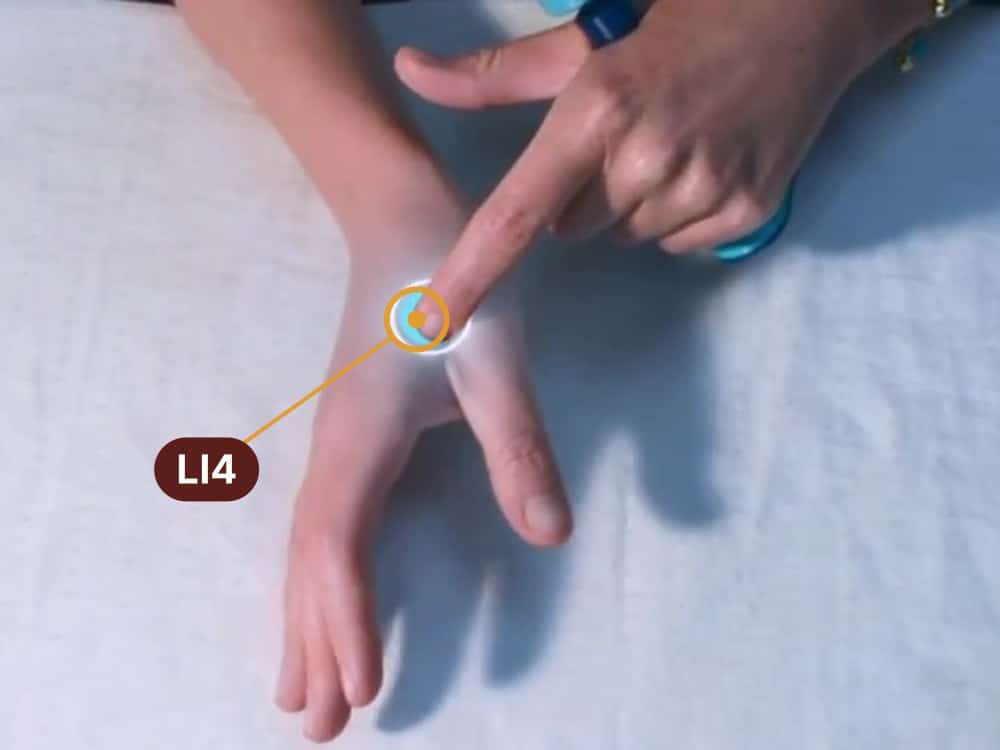
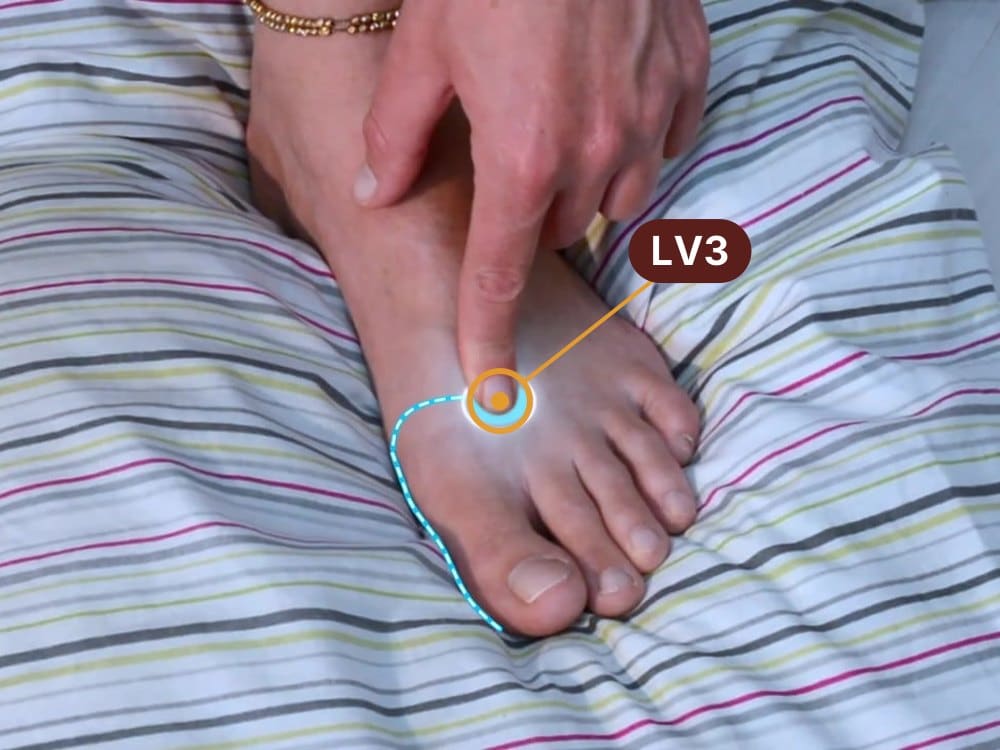
The choice of points rests on three kinds of evidence: clinical research on acupuncture in migraine in general, migraine studies that used exactly these four points, and trials showing measurable nervous-system responses when LI4 and LV3 are stimulated (sections 3 and 4).
LI4 in headache studies. In a study of 137 published acupuncture prescriptions for tension-type headache, LI4 was the fourth most common point, appearing in 49 of them [6]. A similar analysis of 102 headache prescriptions also ranked it fourth [7]. LI4 is also widely used in acupuncture trials for tension-type headache [8].
3. How pressure reaches the brain
Please note: the studies mentioned in this section did not use our devices, and no study has tested them yet. They cover the method and the points only.
Pressure on the skin changes the shape of the skin and the tissue beneath it. Depending on the force, the contact area, the duration and the person, this activates pressure-sensitive nerve endings in the skin and deeper tissue. So the direct biological effect of our devices is a sensory signal from the hands and feet.
These signals travel through the nerves of the hands and legs to the spinal cord, and from there to the brainstem, the thalamus and the cortex. How pain is felt, including migraine pain, is shaped by brain networks that handle sensation, attention and the body’s own pain control [15]. This gives a plausible route by which pressure on the hands and feet can influence pain processing, without stimulating a nerve in the head.
- The gate in the spinal cord. According to the gate control theory of pain, touch and pressure signals are processed in the spinal cord alongside pain signals, and can lower the intensity of the pain that is felt [9].
- The body’s natural substances. Needle and electrical stimulation release endorphins and related substances [10]. Pressure may do the same, but this has not been measured.
- Brain responses to LI4 and LV3. Imaging studies show that stimulating LI4 changes activity in brain areas linked to pain and emotion, and that the response reversed when the stimulation felt sharp or painful [11, 12]. A review of imaging studies mapped brain responses to stimulation at LV3 [13].
- The route runs through the nerves of the arm. In 12 healthy volunteers, blocking the nerves of the arm removed the brain’s response to electroacupuncture at LI4 [14].
That is why the pressure is meant to be clearly felt but comfortable, and never painful.
3.1 Relaxation and the headache cycle
Stress and poor sleep are the headache triggers people report most often. In a review of studies on reported triggers, about 58% named stress and about 41% sleep problems [25]. In a large headache-clinic study, stress was the most common migraine trigger [24]. Stress, poor sleep and pain can feed one another. Use takes place at rest, sitting quietly and breathing slowly, and offers a regular break that may support relaxation.
4. Published research
Please note: the studies in this section did not use our devices, and no study has tested them yet. They cover the method and the points only.
4.1 Reviews
| Review | Studies | Participants | Main finding |
|---|---|---|---|
| Zhang et al. 2025 [1] | 19 randomised trials of Four Gates acupuncture in migraine | 1,312 | Better results than medication or sham acupuncture for headache intensity (VAS difference −1.11; 95% CI −1.50 to −0.73) and attack frequency; moderate to low certainty |
| Linde et al. 2016, Cochrane [2] | 22 trials of acupuncture for episodic migraine | 4,985 | Adding acupuncture to usual care lowered headache frequency; the advantage over sham was statistically significant but small |
| Linde et al. 2016, Cochrane [3] | 12 trials of acupuncture for tension-type headache | — | A course of acupuncture may help people with frequent tension-type headache |
4.2 Trials at the Four Gates points
| Trial | Participants | Comparison | Main finding |
|---|---|---|---|
| Cai et al. 2022 [4] | 110 with migraine | Electroacupuncture at the Four Gates versus the drug flunarizine | Pain scores and migraine days fell in both groups, more in the electroacupuncture group |
| Lin et al. 2014 [5] | 87 with migraine | Four Gates plus points on the Gallbladder meridian | Improvement in migraine intensity, frequency and duration |
4.3 Pressure without needles (acupressure)
| Study | Context | Points | Main finding |
|---|---|---|---|
| Hsieh et al. 2010 [16] | Chronic headache, 28 participants | Head and neck points | Lower pain than with a muscle relaxant, after one month and after 6 months |
| Allais et al. 2012 [17] | Migraine-associated nausea | Acupressure | Clinical assessment of acupressure for nausea during migraine |
| Seydi et al. 2021 [18] | Acute migraine, 84 participants | Eight points, 3 minutes | Pain fell more than with sham pressure or medication alone |
| Asadizeidabadi et al. 2025 [19] | Migraine, review of 12 studies | Various | Mixed but promising results; better trials are needed |
| Dabiri and Shahi 2014 [20] | Labour pain, 149 women | LI4 on both hands | Lower pain scores than with touch or no intervention; the effect faded within an hour |
| Najafi et al. 2018 [21]; Larki et al. 2025 [22] | Labour pain, reviews | Mainly LI4 and SP6 | Both points lowered pain; moderate to low certainty |
| Turgay et al. 2026 [23] | Cannulation pain before dialysis, 131 participants | LI4, 3 minutes | Lower pain than with routine care at all three fistula sites |
What is still missing: we found no published trial of pressure on LI4 alone, or on the four Four Gates points together, in headache.
4.4 How the evidence fits together
| Evidence | What it shows | What it explains |
|---|---|---|
| Established physiology | Pressure on skin and soft tissue creates a sensory nerve signal | Explains how a mechanical device reaches the nervous system |
| Migraine research in general | Trials and reviews support an effect of acupuncture in episodic migraine | Supports the relevance of point stimulation in migraine |
| Four Gates research | Migraine studies used exactly LI4 and LV3 on both sides | The main published basis for choosing the four points |
| Acupressure research | Pressure without needles has been studied in headache, migraine-associated nausea and other pain | Supports the plausibility of a needle-free approach |
| Our engineering | Controlled, repeatable pressure on the same four points at once | Turns the published rationale into a device one person can use alone |
5. Our first tests
We carried out a small, uncontrolled preliminary assessment, and following it we are planning a controlled study.
6. The planned clinical study
A controlled study is planned. The results will be published after the study is completed.
7. Safety and product testing
Our devices work only on the surface of the body. They do not deliver electrical current, heat, radiation or chemicals to the body, and use can be stopped at any time. Possible effects are local and short-lived, such as mild discomfort, tenderness or redness where the units are placed.
7.1 Independent safety testing
The 4 Gates system was tested by Hermon Laboratories in Israel, an ISO/IEC 17025 accredited laboratory (test report TALSAF_EN.53823, March 2025; certificate TALSAF_EN.53823C). The certificate confirms that the tested model meets IEC 62368-1:2023, EN 62368-1:2024+A11:2024, UL 62368-1:2019 and CSA C22.2 No. 62368-1:19.
- Electrical energy: class ES1, the lowest, in normal and fault conditions
- Touch temperature: class TS1; mechanical energy: class MS1
- Simulated fault conditions, including battery charging and discharging faults: passed
- Tested model: internal 3.7 V, 650 mAh lithium battery, charged with an approved 5 V USB-C charger
7.2 Electromagnetic compatibility
Ramot L.V. Ltd has issued an EU Declaration of Conformity for the 4 Gates system (model LV-03-00-00) under the EMC Directive 2014/30/EU, applying EN IEC 55014-1:2021, EN 301 489-1 V2.2.3 and EN 301 489-17 V3.2.4. On this basis the devices carry the CE marking.
7.3 Precautions
- For adults 18 and over.
- Stop immediately if use causes pain, discomfort or any other reaction.
- Do not use on injuries, bruises, swelling or irritated skin.
- If you have heart disease, high blood pressure, epilepsy or another medical condition, or take medicines regularly, consult a healthcare professional first.
- If you are pregnant or breastfeeding, consult a doctor before use. Traditionally, LI4 is avoided in pregnancy.
- Do not use under the influence of alcohol or drugs.
- A sudden, severe or unusual headache needs prompt medical attention.
Our devices are not a substitute for professional medical advice, diagnosis or care.
8. Patent
The technology was developed by us. Ramot L.V. Ltd has filed an international patent application, PCT/IL2025/050595, published as WO2026018237, titled Non-invasive device, system and method for applying acupressure. The application covers key aspects of the device, the system architecture and the method of applying controlled, non-invasive pressure, and reflects several years of development.
9. Limitations and our position
Our devices build on a well-documented anatomical idea. LI4 and LV3 on both sides form the traditional Four Gates combination, and there are migraine trials and reviews on stimulating these points. The wider migraine research supports the relevance of point stimulation, and established physiology explains how pressure on the hands and feet creates a nerve signal that reaches the brain.
The published studies used interventions different from ours, mainly needle acupuncture and electroacupuncture. So we use them to explain the choice of points and why the approach is plausible, not to claim that their results are results of our devices. Our first tests are small and uncontrolled. The controlled study in section 6 is meant to provide direct evidence.
References
- Zhang XR, Zhou L, Zhai JY, et al. Siguan points-based acupuncture treatment for migraine: a systematic review with meta-analysis of clinical efficacy and neurovascular regulatory effects. Complement Ther Clin Pract. 2025;61:102019.
- Linde K, Allais G, Brinkhaus B, et al. Acupuncture for the prevention of episodic migraine. Cochrane Database Syst Rev. 2016;CD001218.
- Linde K, Allais G, Brinkhaus B, et al. Acupuncture for the prevention of tension-type headache. Cochrane Database Syst Rev. 2016;CD007587.
- Cai YW, et al. Electroacupuncture at Siguan points for migraine of liver yang hyperactivity: a randomized controlled trial. Zhongguo Zhen Jiu. 2022;42(5):498–502.
- Lin XM, Yao X, Di Z. Acupuncture at Siguan combined with Gallbladder Meridian acupoints for migraine: a randomized controlled trial. Zhongguo Zhen Jiu. 2014;34(10):947–950.
- Lu L, Wen Q, Hao X, et al. Acupoints for tension-type headache: a literature study based on data mining technology. Evid Based Complement Alternat Med. 2021;2021:5567697.
- Shi JY, Li TT, Yang HT, et al. Acupoints for headache with blood stasis syndrome: a literature study based on data mining technology. J Pain Res. 2024;17.
- Kang W, Xiao X, Fan R, et al. Acupuncture for tension-type headache: a systematic review and meta-analysis of randomized controlled trials. Front Neurol. 2023;13:943495.
- Melzack R, Wall PD. Pain mechanisms: a new theory. Science. 1965;150:971–979.
- Han JS. Acupuncture: neuropeptide release produced by electrical stimulation of different frequencies. Trends Neurosci. 2003;26(1):17–22.
- Hui KK, Liu J, Makris N, et al. Acupuncture modulates the limbic system and subcortical gray structures of the human brain. Hum Brain Mapp. 2000;9(1):13–25.
- Claunch JD, et al. Commonality and specificity of acupuncture action at three acupoints as evidenced by fMRI. Am J Chin Med. 2012;40(4):695–712.
- Rao Y, Ge L, Wu J. A systematic review and coordinate-based meta-analysis of fMRI studies on acupuncture at LV3. Front Neurosci. 2024;18:1341567.
- Gu W, Jiang W, He J, et al. Blockade of the brachial plexus abolishes activation of specific brain regions by electroacupuncture at LI4: a functional MRI study. Acupunct Med. 2015;33(6):457–464.
- Goadsby PJ, Holland PR, Martins-Oliveira M, et al. Pathophysiology of migraine: a disorder of sensory processing. Physiol Rev. 2017;97(2):553–622.
- Hsieh LLC, Liou HH, Lee LH, et al. Effect of acupressure and trigger points in treating headache: a randomized controlled trial. Am J Chin Med. 2010;38(1):1–14.
- Allais G, et al. Acupressure in the control of migraine-associated nausea. Neurol Sci. 2012;33 Suppl 1:S207–S210.
- Seydi P, Bagheri-Nesami M, Mohammadpour-Tahamtan RA, et al. Efficacy of acupressure on intensity of acute migraine in patients attending an emergency department. J Mazandaran Univ Med Sci. 2021;31(203):83–94.
- Asadizeidabadi A, Hosseini S, Ataei A, et al. Effect of acupressure on migraine: a systematic review and meta-analysis. Adv Tradit Med. 2025;25(2):385–393.
- Dabiri F, Shahi A. The effect of LI4 acupressure on labor pain intensity and duration of labor: a randomized controlled trial. Oman Med J. 2014;29(6):425–429.
- Najafi F, et al. An evaluation of acupressure on the SP6 and LI4 points on the pain severity and length of labor: a systematic review and meta-analysis. Iran J Nurs Midwifery Res. 2018;23:1–7.
- Larki M, Karimi L, Jahanfar S, et al. An updated systematic review and meta-analysis and GRADE assessment on the effectiveness of acupressure in managing labor pain. BMC Complement Med Ther. 2025;25:170.
- Turgay G, Çevik B, Eskigülek Y, et al. Hegu point acupressure for cannulation pain across fistula sites: randomized controlled trial. EXPLORE. 2026;22(2):103324.
- Kelman L. The triggers or precipitants of the acute migraine attack. Cephalalgia. 2007;27(5):394–402.
- Pellegrino ABW, et al. Perceived triggers of primary headache disorders: a meta-analysis. Cephalalgia. 2018;38(6):1188–1198.
- Diener HC, Tassorelli C, Dodick DW, et al. Guidelines of the International Headache Society for controlled trials of acute treatment of migraine attacks in adults: fourth edition. Cephalalgia. 2019;39(6):687–710.
- Tepper SJ, Grosberg B, Daniel O, et al. Migraine treatment with external concurrent occipital and trigeminal neurostimulation: a randomized controlled trial. Headache. 2022;62(8):989–1001.
- Yarnitsky D, Dodick DW, Grosberg BM, et al. Remote electrical neuromodulation (REN) relieves acute migraine: a randomized, double-blind, placebo-controlled, multicenter trial. Headache. 2019;59(8):1240–1252.
- Kuruvilla DE, Mann JI, Tepper SJ, et al. Phase 3 randomized, double-blind, sham-controlled trial of e-TNS for the acute treatment of migraine (TEAM). Sci Rep. 2022;12:5110.